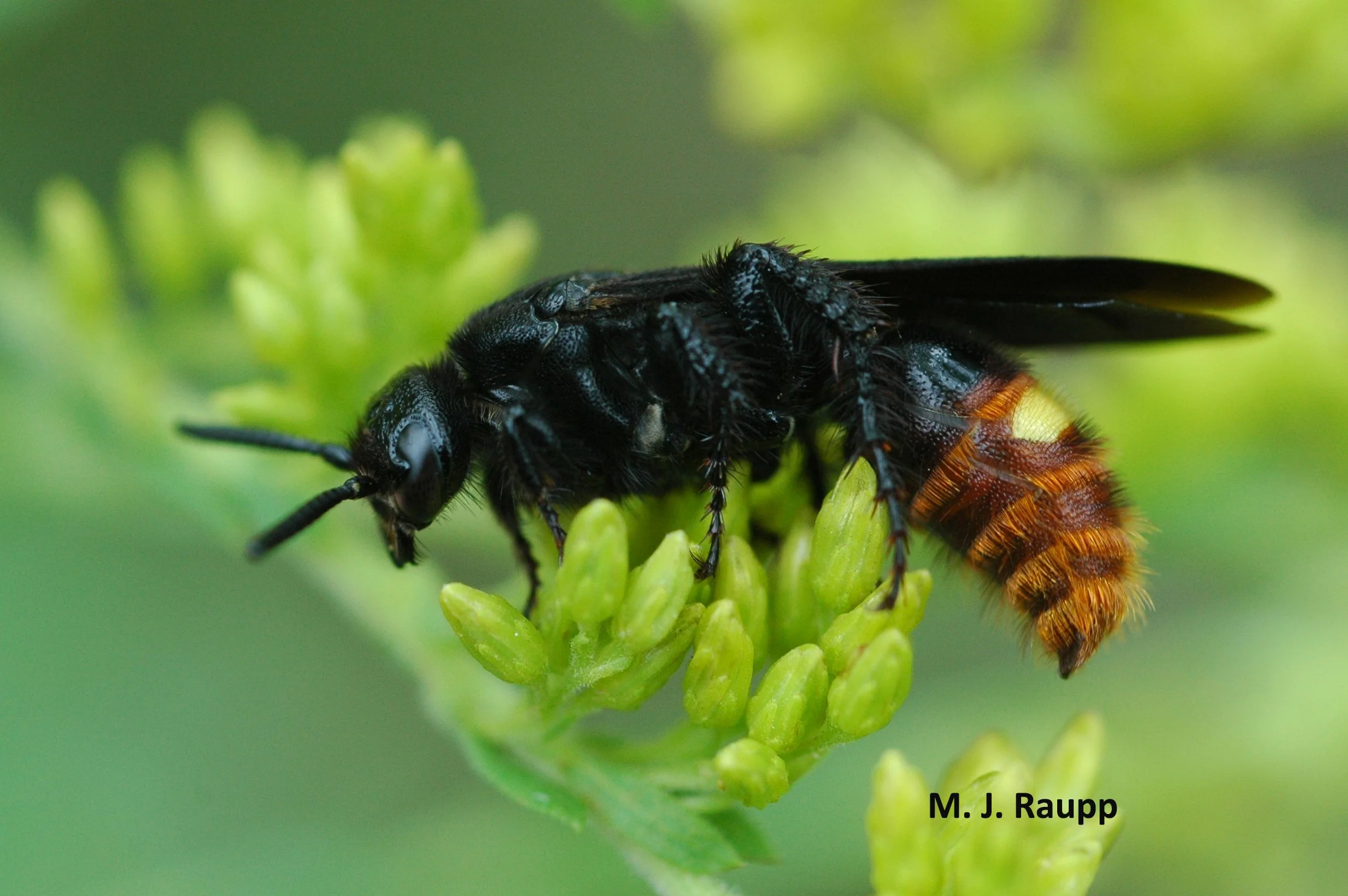
This week let’s visit a trio of gorgeous and really cool wasps intent on annihilating dastardly beetle pests in our lawns and gardens. The beetle pests these wasps attack include larval stages (a.k.a. white grubs) of green June beetles, Japanese beetles, Oriental beetles, Asiatic garden beetles, and other members of the scarab clan that dwell in soil and devour roots of our lawn grasses, annual, and perennial plants. As adults these beetles, known as scarabs, strip leaves and blossoms of hundreds of species of ornamental plants and wholesome vegetables. Adequate spring and summer rains conducive to grub survival have turned my flower beds into ideal breeding sites for these rascals. But in Mother Nature’s system of checks and balances, it is not unusual to see populations of predators and parasites rise shortly after populations of their prey increase.
Mints and asters bring digger wasps like Scolia dubia, Scolia nobilitata, and Scolia bicincta to your garden on sunny days in late summer and autumn. Scolia dubia is easy to know by the two yellow patches on the sides of its furry reddish abdomen. Scolia nobilitata has two pairs of orange or yellowish spots on its black abdomen and their cousin Scolia bicincta has two brilliant white bands wrapping around the dorsal surface of the abdomen. After tanking up on energy-rich nectar, they will search for white grubs in your lawn and gardens, dig into the soil, and deposit eggs on hapless grubs. Upon hatching, wasp larvae devour the grubs and thereby help to rid your landscape of these noxious pests. These wasps don’t harm humans or pets, so plant some mints and asters and enjoy the show. Video credit: Marie Rojas and Michael J. Raupp
Over the past week or so, several folks have commented on hordes of dark winged wasps cruising back and forth a foot or so over their turf. Most of these sightings are digger wasps, members of a family known as Scoliidae. The digger wasp moniker stems from the impressive ability of these fierce fliers to locate white grubs beneath the surface of the earth, tunnel through the dirt, deliver a paralyzing sting, and deposit an egg on the skin of the grub. The hapless white grub is incapable of removing the egg, which soon hatches and the parasitic larva of the digger wasp slowly consumes its living victim. Glad I’m not a white grub. After completing its development during summer and autumn, the wasp larva spins a silken cocoon, pupates, and then passes the winter in the burrow created by the grub. Fresh, new wasps emerge as adults the following August and they are now busy in our landscapes gaining nutrition in the form of nectar and pollen as they visit flowers in our gardens and landscapes.
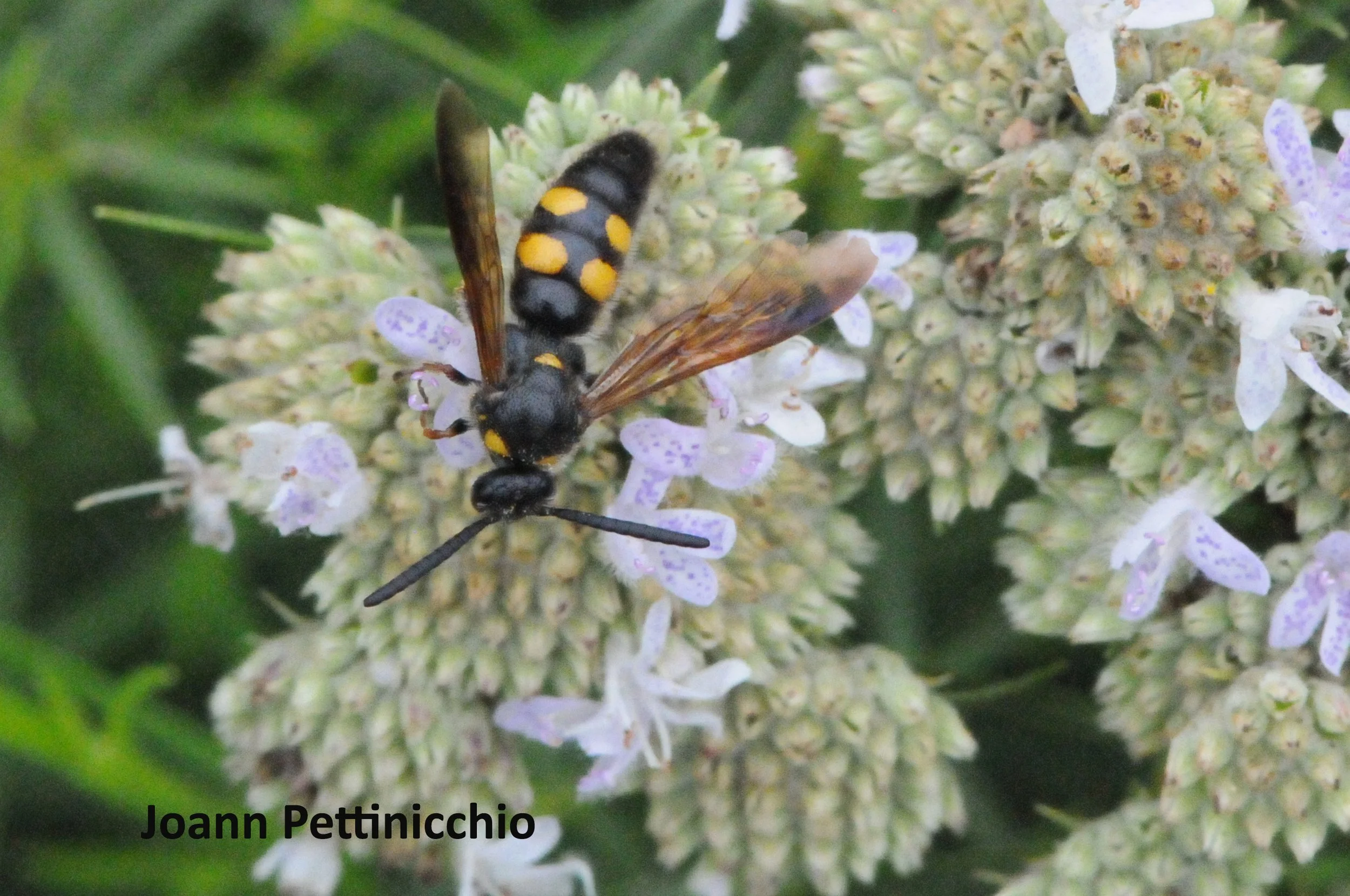
When not hunting white grubs, Scolia dubia is often found nectaring on flowers during August. Photo credit: Joann Pettinicchio
Several species of digger wasps can be found in the DMV, and three in the limelight this time of year are the blue-winged digger wasp, Scolia dubia, the noble digger wasp, Scolia nobilitata, and the double-banded digger wasp, Scolia bicincta. Scolia dubia sports striking iridescent blue-black wings. Its body is black excepting the end of its fuzzy abdomen, which is reddish brown. Scolia dubia is easily recognized by one pair of bright yellow spots on either side of its abdomen. Its cousin, Scolia nobilitata, has smoky brown wings with two pairs of yellow or off-white spots on its abdomen. Scolia bicincta has dark black wings and two brilliant white bands wrapping around the dorsal surface of the abdomen. These colorful beauties need energy to search for grubs and tunnel underground to find their victims. They are often seen carbo-loading in preparation for the hunt on nectar-rich members of the mint family (Lamiaceae) such as mountain mint and spotted horse mint, and members of the aster family (Asteraceae) such as goldenrod and wingstem, a.k.a. yellow ironweed.
Whether it’s small white grubs in the soil or zany green June beetle grubs that crawl on their back across the ground, these pests face an awesome grim reaper when Scolia digger wasps come to my garden. Video credit: Michael J. Raupp
Lawns and landscape beds rampant with white grubs often attract squadrons of digger wasps flying in tight figure-eight patterns just above the ground, presumably hunting for prey. While they might appear scary, please understand that these wasps are not aggressive towards humans and that they are highly beneficial by virtue of the beat-down they put on white grubs, as well as pollination of some of our favorite plants. You can befriend these beneficial wasps by providing nectar sources, such as mints and asters, in your landscape and thereby invite them to hang around and find some pestiferous white grubs to serve as food for their offspring. As part of Mother Nature’s system of checks and balances, plant some flowers, sit back and relax on a warm autumn day, let them do their work, and enjoy the show.
Acknowledgements
Bug of the Week thanks Marie Rojas for the awesome video of blue-winged digger wasps nectaring on mountain mint and Joann Pettinicchio for the pretty picture of the noble digger wasp. The wonderful books “Destructive Turfgrass Insects” by Dan Potter and “Bees, Wasps, and Ants” by Eric Grissell were used as references.